
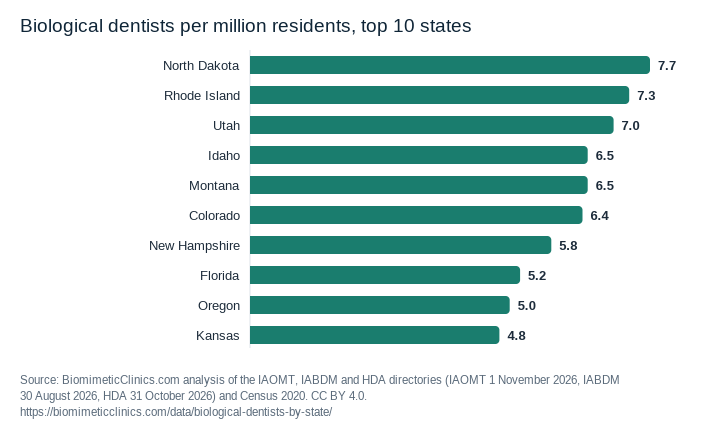
Per resident, North Dakota has the most biological dentists, 7.7 per million residents, followed by Rhode Island (7.3) and Utah (7.0). By number, California has the most, 172. Mississippi has the fewest per resident, 1.0 per million.
- 7.7per million in North Dakota, the highest
- 3.1per million in the median state
- 3.6per million nationally
- 1.0per million in Mississippi, the lowest
The ranking
The ranking divides each state's biological dentists, counted once across the IAOMT, IABDM and HDA directories, by its Census 2020 population. Nationally there are 3.6 per million residents. The ten highest are in the chart; every state is in the table.
| State | Rank | Per million residents | Biological dentists | Residents within 50 miles of one |
|---|---|---|---|---|
| North Dakota | 1 | 7.7 | 6 | 51.9% |
| Rhode Island | 2 | 7.3 | 8 | 100.0% |
| Utah | 3 | 7.0 | 23 | 93.3% |
| Idaho | 4 | 6.5 | 12 | 78.9% |
| Montana | 5 | 6.5 | 7 | 52.7% |
| Colorado | 6 | 6.4 | 37 | 94.8% |
| New Hampshire | 7 | 5.8 | 8 | 89.4% |
| Florida | 8 | 5.2 | 112 | 96.5% |
| Oregon | 9 | 5.0 | 21 | 84.8% |
| Kansas | 10 | 4.8 | 14 | 77.5% |
| Texas | 11 | 4.5 | 131 | 88.2% |
| California | 12 | 4.4 | 172 | 97.6% |
| Connecticut | 13 | 4.2 | 15 | 100.0% |
| Washington | 14 | 4.2 | 32 | 88.1% |
| Alaska | 15 | 4.1 | 3 | 56.1% |
| Arizona | 16 | 4.1 | 29 | 83.2% |
| Hawaii | 17 | 4.1 | 6 | 91.4% |
| Minnesota | 18 | 4.0 | 23 | 72.5% |
| North Carolina | 19 | 3.9 | 41 | 88.8% |
| South Carolina | 20 | 3.9 | 20 | 94.6% |
| New Jersey | 21 | 3.8 | 35 | 100.0% |
| Michigan | 22 | 3.7 | 37 | 89.0% |
| Nebraska | 23 | 3.6 | 7 | 78.6% |
| Wisconsin | 24 | 3.4 | 20 | 85.7% |
| Illinois | 25 | 3.2 | 41 | 88.0% |
| Georgia | 26 | 3.1 | 33 | 84.6% |
| Louisiana | 27 | 3.0 | 14 | 76.2% |
| Oklahoma | 28 | 3.0 | 12 | 77.9% |
| District of Columbia | 29 | 2.9 | 2 | 100.0% |
| Maine | 30 | 2.9 | 4 | 85.9% |
| Tennessee | 31 | 2.9 | 20 | 85.4% |
| Iowa | 32 | 2.8 | 9 | 66.8% |
| Massachusetts | 33 | 2.8 | 20 | 100.0% |
| Indiana | 34 | 2.7 | 18 | 95.1% |
| Pennsylvania | 35 | 2.7 | 35 | 93.5% |
| Maryland | 36 | 2.6 | 16 | 99.6% |
| New York | 37 | 2.6 | 53 | 95.5% |
| Missouri | 38 | 2.4 | 15 | 78.6% |
| Arkansas | 39 | 2.3 | 7 | 46.7% |
| Nevada | 40 | 2.3 | 7 | 95.2% |
| South Dakota | 41 | 2.3 | 2 | 23.4% |
| Ohio | 42 | 2.2 | 26 | 96.2% |
| West Virginia | 43 | 2.2 | 4 | 51.6% |
| Virginia | 44 | 2.1 | 18 | 84.5% |
| Delaware | 45 | 2.0 | 2 | 100.0% |
| Kentucky | 46 | 2.0 | 9 | 74.3% |
| New Mexico | 47 | 1.9 | 4 | 69.0% |
| Wyoming | 48 | 1.7 | 1 | 21.8% |
| Vermont | 49 | 1.6 | 1 | 74.9% |
| Alabama | 50 | 1.4 | 7 | 67.8% |
| Mississippi | 51 | 1.0 | 3 | 56.3% |
Biological dentists: listed by the IAOMT, IABDM or HDA, each counted once (directory reads: IAOMT 1 November 2026, IABDM 30 August 2026, HDA 31 October 2026). Residents: Census 2020. Ties share the order of their names.
Small states move fastest
In a state with few residents, one or two dentists change the rate a lot, so the top of the ranking is mostly smaller states. Among the states with at least ten million residents, Florida has the most per resident (5.2 per million) and Ohio the fewest (2.2). The lowest overall are Mississippi (1.0), Alabama (1.4) and Vermont (1.6).
A rate is not distance: a state with few dentists per resident can still have most of its people near one, and the reverse. How far residents live from the nearest one is on the access page.
How these figures are counted, and why other counts differ
- Biological dentists. Dentists listed by the IAOMT, IABDM or HDA, each counted once by first and last name within a state. Directories read: IAOMT 1 November 2026, HDA 31 October 2026, IABDM 30 August 2026.
- Residents. Census 2020, the 50 states and the District of Columbia.
- Ties are ordered by state name.
How to cite this page
The figures, tables and charts on this page are published under CC BY 4.0: you may quote and reuse them, crediting BiomimeticClinics.com with a link to this page.
BiomimeticClinics.com. Which States Have the Most Biological Dentists? Updated 2 November 2026. https://biomimeticclinics.com/data/biological-dentists-by-state/
Frequently asked questions
Which state has the most biological dentists?
By number, California (172). Per resident, North Dakota (7.7 per million).
Which state has the fewest biological dentists per resident?
Mississippi, with 1.0 per million residents.
How do I find a biological dentist in my state?
Open your state in the directory, or send an introduction request with the form on this page.